

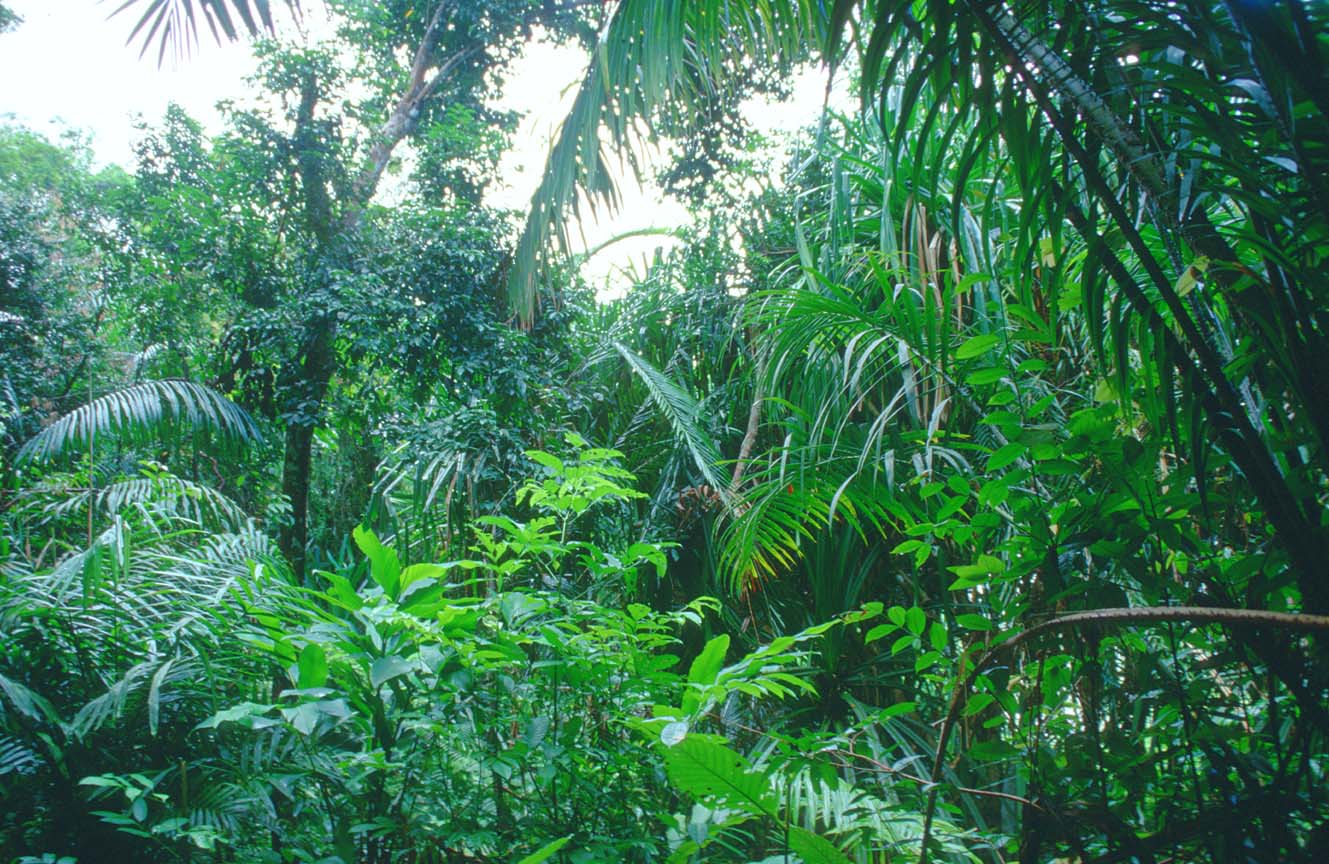
The tropical rain forest is a forest of tall trees in a region of year-round warmth. An average of 50 to 260 inches (125 to 660 cm.) of rain falls yearly.
Rain forests belong to the tropical wet climate group. The temperature in a rain forest rarely gets higher than 93 °F (34 °C) or drops below 68 °F (20 °C); average humidity is between 77 and 88%; rainfall is often more than 100 inches a year. There is usually a brief season of less rain. In monsoonal areas, there is a real dry season. Almost all rain forests lie near the equator.
Rainforests now cover less than 6% of Earth's land surface. Scientists estimate that more than half of all the world's plant and animal species live in tropical rain forests. Tropical rainforests produce 40% of Earth's oxygen.
A tropical rain forest has more kinds of trees than any other area in the world. Scientists have counted about 100 to 300 species in one 2 1/2-acre (1-hectare) area in South America. Seventy percent of the plants in the rainforest are trees.
About 1/4 of all the medicines we use come from rainforest plants. Curare comes from a tropical vine, and is used as an anesthetic and to relax muscles during surgery. Quinine, from the cinchona tree, is used to treat malaria. A person with lymphocytic leukemia has a 99% chance that the disease will go into remission because of the rosy periwinkle. More than 1,400 varieties of tropical plants are thought to be potential cures for cancer.
All tropical rain forests resemble one another in some ways. Many of the trees have straight trunks that don't branch out for 100 feet or more. There is no sense in growing branches below the canopy where there is little light. The majority of the trees have smooth, thin bark because there is no need to protect the them from water loss and freezing temperatures. It also makes it difficult for epiphytes and plant parasites to get a hold on the trunks. The bark of different species is so similar that it is difficult to identify a tree by its bark. Many trees can only be identified by their flowers.
Despite these differences, each of the three largest rainforests--the American, the African, and the Asian--has a different group of animal and plant species. Each rain forest has many species of monkeys, all of which differ from the species of the other two rain forests. In addition, different areas of the same rain forest may have different species. Many kinds of trees that grow in the mountains of the Amazon rain forest do not grow in the lowlands of that same forest.
There are four very distinct layers of trees in a tropical rain forest. These layers have been identified as the emergent, upper canopy, understory, and forest floor.

- Emergent trees are spaced wide apart, and are 100 to 240 feet tall with umbrella-shaped canopies that grow above the forest. Because emergent trees are exposed to drying winds, they tend to have small, pointed leaves. Some species lose their leaves during the brief dry season in monsoon rainforests. These giant trees have straight, smooth trunks with few branches. Their root system is very shallow, and to support their size they grow buttresses that can spread out to a distance of 30 feet.
- The upper canopy of 60 to 130 foot trees allows light to be easily available at the top of this layer, but greatly reduced any light below it. Most of the rainforest's animals live in the upper canopy. There is so much food available at this level that some animals never go down to the forest floor. The leaves have "drip spouts" that allows rain to run off. This keeps them dry and prevents mold and mildew from forming in the humid environment.
- The understory, or lower canopy, consists of 60 foot trees. This layer is made up of the trunks of canopy trees, shrubs, plants and small trees. There is little air movement. As a result the humidity is constantly high. This level is in constant shade.
- The forest floor is usually completely shaded, except where a canopy tree has fallen and created an opening. Most areas of the forest floor receive so little light that few bushes or herbs can grow there. As a result, a person can easily walk through most parts of a tropical rain forest. Less than 1 % of the light that strikes the top of the forest penetrates to the forest floor. The top soil is very thin and of poor quality. A lot of litter falls to the ground where it is quickly broken down by decomposers like termites, earthworms and fungi. The heat and humidity further help to break down the litter. This organic matter is then just as quickly absorbed by the trees' shallow roots.
- drip tips
- Plant Life
Besides these four layers, a shrub/sapling layer receives about 3 % of the light that filters in through the canopies. These stunted trees are capable of a sudden growth surge when a gap in the canopy opens above them.
The air beneath the lower canopy is almost always humid. The trees themselves give off water through the pores (stomata) of their leaves. This process, called transpiration, can account for as much as half of the precipitation in the rain forest.
Rainforest plants have made many adaptations to their environment. With over 80 inches of rain per year, plants have made adaptations that helps them shed water off their leaves quickly so the branches don't get weighed down and break. Many plants have drip tips and grooved leaves, and some leaves have oily coatings to shed water. To absorb as much sunlight as possible on the dark understory, leaves are very large. Some trees have leaf stalks that turn with the movement of the sun so they always absorb the maximum amount of light. Leaves in the upper canopy are dark green, small and leathery to reduce water loss in the strong sunlight. Some trees will grow large leaves at the lower canopy level and small leaves in the upper canopy. Other plants grow in the upper canopy on larger trees to get sunlight. These are the epiphytes such as orchids and bromeliads. Many trees have buttress and stilt roots for extra support in the shallow, wet soil of the rainforests.
Over 2,500 species of vines grow in the rainforest. Lianas start off as small shrubs that grow on the forest floor. To reach the sunlight in the upper canopy it sends out tendrils to grab sapling trees. The liana and the tree grow towards the canopy together. The vines grow from one tree to another and make up 40% of the canopy leaves. The rattan vine has spikes on the underside of its leaves that point backwards to grab onto sapling trees. Other "strangler" vines will use trees as support and grow thicker and thicker as they reach the canopy, strangling its host tree. They look like trees whose centers have been hollowed out.
Dominant species do not exist in tropical rainforests. Lowland dipterocarp forest can consist of many different species of Dipterocarpaceae, but not all of the same species. Trees of the same species are very seldom found growing close together. This bio diversity and separation of the species prevents mass contamination and die-off from disease or insect infestation. Bio diversity also insures that there will be enough pollinators to take care of each species' needs. Animals depend on the staggered blooming and fruiting of rainforest plants to supply them with a year-round source of food.
Where the Rainforests Are Found
The tropical rain forest can be found in three major geographical areas around the world.
- Central America in the the Amazon river basin.
- Africa - Zaire basin, with a small area in West Africa; also eastern Madagascar.
- Indo-Malaysia - west coast of India, Assam, Southeast Asia, New Guinea and Queensland, Australia.


Forests of the Tide
At the intersection of land and sea, mangrove forests support a wealth of life, from starfish to people, and may be more important to the health of the planet than we ever realized.
Mangrove Forests
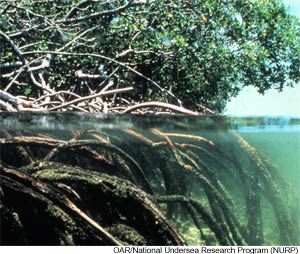 Mangrove forests thrive near the mouths of large rivers where river deltas provide lots of sediment (sand and mud). Mangrove roots collect sediments and slow the water's flow, helping to protect the coastline and preventing erosion. Over time, the roots can collect enough debris and mud to extend the edge of the coastline further out.
Mangrove forests are teeming with life. Shorebirds, crab-eating monkeys, and fishing cats all make the mangrove home. Mangroves provide a safe haven and a nursery for a variety of fish, birds, crustaceans, and shellfish.
Mangrove Trees
A mangrove is a tropical maritime tree or shrub of the genus Rhizophora. Mangroves have special aerial roots and salt-filtering tap roots that enable them to thrive in brackish water (brackish water is salty, but not as salty as sea water).
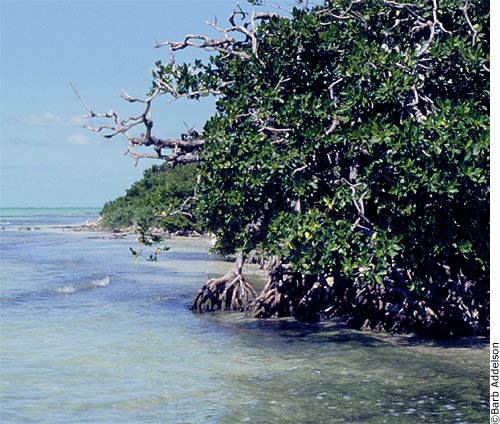
There are several species of mangrove trees found all over the world. Some prefer more salinity, while others like to be very close to a large fresh water source (such as a river). Some prefer areas that are sheltered from waves. Some species have their roots covered with sea water every day during high tide. Others are more sensitive to salinity, and grow closer to the shore. Other species grow on dry land, but are still part of the ecosystem.
Mangroves need to keep their trunk and leaves above the water line. Yet they also need to be firmly attached to the ground so they are not moved by waves. There are three types of mangrove roots that help in this process:
 1. Support roots which directly pierce the soil.
2. Level-growing roots which twist upward and downwards, with the upward twists emerging on the water surface. 3. Level-growing roots whose downward twists (sub-roots) appear on the water surface.
Any part of a root that appears above the water line channels oxygen to the plant below the water line. Over time as soil begins to build up, these roots produce additional roots that become embedded in the soil. Where Are Mangroves Found?
There are 15.9 million hectares (over 60,000 square miles) of mangrove forests in the warm waters of tropical oceans all over the world. Along the Atlantic coast they are found from Florida all the way down to Argentina. Mangroves grow on both the western and eastern coasts of Africa. They stretch into India, Burma, and south-east Asia. Mangrove forests are also common in New Zealand and Australia.
Saving the Mangroves
For centuries mangrove areas have been used for timber, mining, agriculture, harbor development and human settlements. Mangrove areas were used for commercial shrimp farming during the late 70's and early 80's. However, using mangrove areas for shrimp farming proved to be unsustainable.
Many governments have realized how necessary mangroves really are to the overall environment and have adopted mangrove restoration and conservation programs. Strict legislation to protect mangroves is in place in many countries.
Indonesia is home to over a quarter of the world's mangrove population. Coastal fish farmers on the Indonesian island of Java are given 4–5 hectares of land, but are required to plant mangroves on 20% of it. Seeds are gathered from budding sprouts and planted 6 to 9 feet apart. This sort of reforestation improves the environment, while feeding people and encouraging the economy. This is a sustainable long term solution.
Mangroves live life on the edge. With one foot on land and one in the sea, these botanical amphibians occupy a zone of desiccating heat, choking mud, and salt levels that would kill an ordinary plant within hours. Yet the forests mangroves form are among the most productive and biologically complex ecosystems on Earth. Birds roost in the canopy, shellfish attach themselves to the roots, and snakes and crocodiles come to hunt. Mangroves provide nursery grounds for fish; a food source for monkeys, deer, tree-climbing crabs, even kangaroos; and a nectar source for bats and honeybees.
As a group, mangroves can't be defined too closely. There are some 70 species from two dozen families—among them palm, hibiscus, holly, plumbago, acanthus, legumes, and myrtle. They range from prostrate shrubs to 200-foot-high (60 meters) timber trees. Though most prolific in Southeast Asia, where they are thought to have originated, mangroves circle the globe. Most live within 30 degrees of the Equator, but a few hardy types have adapted to temperate climates, and one lives as far from the tropical sun as New Zealand. Wherever they live, they share one thing in common: They're brilliant adapters. Each mangrove has an ultrafiltration system to keep much of the salt out and a complex root system that allows it to survive in the intertidal zone. Some have snorkel-like roots called pneumatophores that stick out of the mud to help them take in air; others use prop roots or buttresses to keep their trunks upright in the soft sediments at tide's edge.
These plants are also landbuilders par excellence. Some Aborigines in northern Australia believe one mangrove species resembles their primal ancestor, Giyapara, who walked across the mudflats and brought the tree into existence. The plants' interlocking roots stop riverborne sediments from coursing out to sea, and their trunks and branches serve as a palisade that diminishes the erosive power of waves.

Interesting post. I Have Been wondering about this issue, so thanks for posting. Pretty cool post.It 's really very nice and Useful post.Thanks Forestry Mulching
ReplyDeleteKeep it up
ReplyDelete